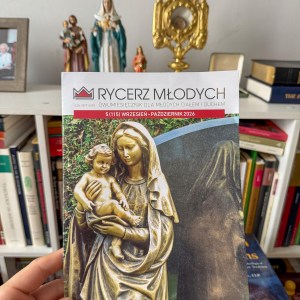
A nice surprise in the mail from Poland today: my faith reversion story, “A Chapel in the Rain,” is featured in the September–October issue of Rycerz Młodych, a Catholic magazine published by the Conventual Franciscans at Niepokalanów, the “City of the Immaculata” founded by St. Maximilian Kolbe.
I wrote about how I chose St. Maximilian as my Confirmation patron almost by accident at 13, walked away from the faith not long afterward, and eventually found my way back through the open doors of a small Franciscan chapel in Baltimore during a rainstorm.
It means a great deal to have that story published at Niepokalanów. St. Maximilian founded the community in 1927 and built it into an extraordinary center of Catholic publishing and evangelization, with hundreds of friars and publications reaching enormous audiences before the Second World War. Rycerz Młodych is published there today by the Franciscans who continue that apostolate. For a story about the unexpected role St. Maximilian and the Franciscans have played in my own return to the faith, I can hardly imagine a more fitting place for it to appear.
Very grateful to the editors for sharing my story with their Polish readers.
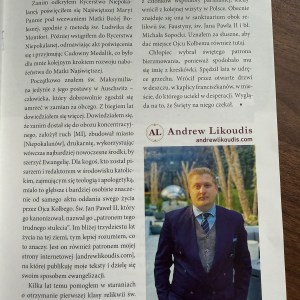
Frankly, I chose St. Maximilian Kolbe as my Confirmation patron by accident. When I was about 13 years old, I was an avid fan of the animated series Yu-Gi-Oh!, whose character was a wealthy, gray-haired villain named Maximillion Pegasus. I liked the name—and that was it. But God has a sense of humor and takes us seriously, even when we do not take ourselves seriously.
Confirmation was not some significant sacramental experience for me, but rather marked my departure from the faith I was raised in. I went through with Confirmation mainly because I wanted to please my parents. Shortly afterward, I abandoned the faith completely. Between the ages of 13 and 18, I passed through pantheism and New Age beliefs and entered a period of militant atheism. It was not so much that I struggled with God; I was convinced that He did not exist, and that Christianity was simply an instrument of political and social control.
Yet through all of this, as a teenager I was afflicted by depression, experienced existential anxiety, and had a sense of a genuine lack of identity and purpose. I was steeped in cultural relativism and postmodernism and felt that I was slowly losing my soul. The accumulated weight of a life that was disordered and cut off from that for which it had been created finally caught up with me.
At 18, my life in New York fell apart. I had been living with my grandparents for several years so that I could finish high school after my parents moved out of state, and at the end, within a week my car broke down, I lost my job delivering pizza, and I was told that now that I was an adult, it was time for me to get a place of my own. With no savings, no job, no prospects, and no time, I packed my bags and booked a Greyhound bus to Baltimore. I lived on the charity of family and friends until their patience ran out.
After about a year in Baltimore—shortly after moving into a new apartment, at the lowest point of my mental and emotional well-being—I went out before dawn to run through a neighborhood I barely knew, listening on repeat to three songs on an MP3 player I had received as a gift.
After I had run several blocks through the city, a torrential rain began to fall. I took shelter beneath the eaves of a small nearby chapel. Instinctively, I tried the door and found it open. God, as it turns out, does not close the door on those who have walked away from Him.
It was a modest and quite modern chapel: a few stained-glass windows, nothing extraordinary. I sat there the entire time the rain fell, until it stopped, but the peace I felt in those few moments was something I had never felt before and could not explain. I had almost forgotten that Jesus lived there, in the tabernacle.
I returned later and discovered St. Casimir Parish, with its chapel of St. Joseph of Cupertino, run by the Conventual Franciscans. By the grace of God and His patience, I made my first sacramental confession in five years.
For near a decade, by chance, my two spiritual directors were Franciscans, although neither of them came from that parish. Each of them eventually gifted me a relic of a Franciscan saint: one, St. Joseph of Cupertino, the namesake of the chapel in which I had my conversion; the other, St. Padre Pio. The latter relic, on the advice of a spiritual director, I later gave to someone in crisis who needed the companionship of the saint more than I did.
I recently finished my master’s degree at Franciscan University of Steubenville, though its Franciscan identity had nothing to do with why I chose it. Looking back at all these seemingly unrelated turns in my life, however, St. Francis seems to have been quietly accompanying me all along.
Before I discovered the Militia Immaculatae, St. Maximilian Kolbe’s movement of Marian consecration and evangelization, I consecrated myself to the Blessed Virgin Mary under the title of Our Lady of Sorrows, according to the method of St. Louis de Montfort. Later I joined the Militia Immaculatae, reciting their act of consecration and receiving the Miraculous Medal, which for me was another step in the development of my devotion to the Blessed Mother.
At first, I knew St. Maximilian only for what he did at Auschwitz—the man who voluntarily agreed to die in place of a stranger. Over the years, I learned more. I learned that before he was sent to the concentration camp, he founded the Militia Immaculatae, built the city of Niepokalanów, the “City of the Immaculata,” into one of the largest Catholic publishing centers in the world. By the eve of the Second World War, nearly 800 friars lived and worked there, and its flagship magazine, Rycerz Niepokalanej, had a circulation approaching one million copies a month. Kolbe had harnessed the most modern means of communication available to him to spread the Gospel and devotion to the Immaculata on an extraordinary scale. For someone who became a writer and editor in the Catholic world, working in theology and apologetics, this took on a deeper and more personal significance for me than Father Kolbe’s act of giving his life did.
St. John Paul II, who canonized him, called him the “patron of this difficult century.” The closer I get to thirty years of life on this earth, the better I understand what that means. He is also the patron of my website, where I publish my writing and share my own way of evangelizing.
A few years ago, I coordinated the effort to obtain a first-class relic of St. Maximilian for Holy Rosary Parish in Baltimore—a Polish parish and the archdiocesan Shrine of Divine Mercy. The relic was brought by one of the members of the parish community when she returned from a subsequent visit to Poland. Today it is kept in the sanctuary beside relics of St. Faustina, St. John Paul II, and Blessed Michał Sopoćko. I thought it fitting that Father Kolbe should have a place there as well.
A boy chose his Confirmation saint because he liked the name of a cartoon character. He spent years suffocating in sin and atheistic despair. He returned through an open door in the rain, in a Franciscan chapel, in the city to which he had fled in desperation.
It seems that the saint had been waiting for him.
Cover photo courtesy of Donald Reese Photography

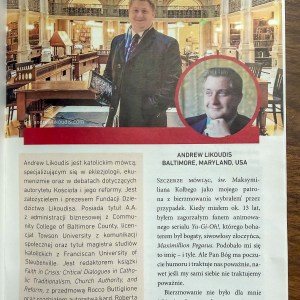
Andrew Likoudis is a Catholic scholar working in ecclesiology, ecumenism, and liturgy. He serves as Digital Editor of Where Peter Is and holds an M.A. in Catholic Studies from Franciscan University of Steubenville and a B.S. in Communication Studies from Towson University. He is the author of To His Face: Indefectibility and the Problem of Dissent (En Route, 2026), with a foreword by Robert Fastiggi and an afterword by Emmett O’Regan, and he organized and edited Faith in Crisis (En Route, 2025), a 40-chapter volume drawing some thirty contributors—among them Cardinal Robert Sarah, Timothy O'Malley, Jimmy Akin, and Mike Aquilina—with a foreword by Rocco Buttiglione, praised in Word on Fire’s Evangelization & Culture journal as “an impressive labor of love.” His most recent editorial work includes the fiftieth-anniversary edition of Yves Congar’s Challenge to the Church: The Case of Archbishop Lefebvre (En Route, 2026), which he edited and introduced, with a foreword by Larry Chapp, and the third edition of James Likoudis’s Ending the Byzantine Greek Schism (Emmaus Road, 2026), with a foreword by Scott Hahn. In all he has authored, edited, or compiled twelve volumes on Catholic ecclesiology and the papacy, and published more than 60 articles in outlets including the National Catholic Register, Catholic Review, Philosophy Now, Where Peter Is, and Fellowship & Fairydust Magazine.
He is the grandson of Catholic apologist James Likoudis, President Emeritus of Catholics United for the Faith, and the nephew and godson of Paul Likoudis, longtime editor of The Wanderer, the oldest national Catholic weekly in the US. As founder and president of the Likoudis Legacy Foundation, which co-sponsored the 30th Orientale Lumen Conference attended by bishops of the Catholic and Orthodox Churches, he directs the foundation’s ecumenical journal The Kydones Review, which carries a foreword from Archbishop Flavio Pace, the Secretary of the Vatican’s Dicastery for Promoting Christian Unity. He writes frequently at his Substack, Tradition & Renewal, and is a parishioner at America’s First Cathedral. He enjoys kayaking, bachata, tennis, and chess. More at andrewlikoudis.com.



Popular Posts